Operating expenditures and corporate sustainability are no longer parallel conversations in the commercial automotive retail sector—they have completely converged. Modern automotive dealerships face unprecedented energy demands. Beyond traditional high-intensity showroom lighting, full-scale service bays, and extensive lot illumination, the aggressive scaling of Electric Vehicle (EV) infrastructure requires immediate grid capacity upgrades and drives compounding electricity costs.
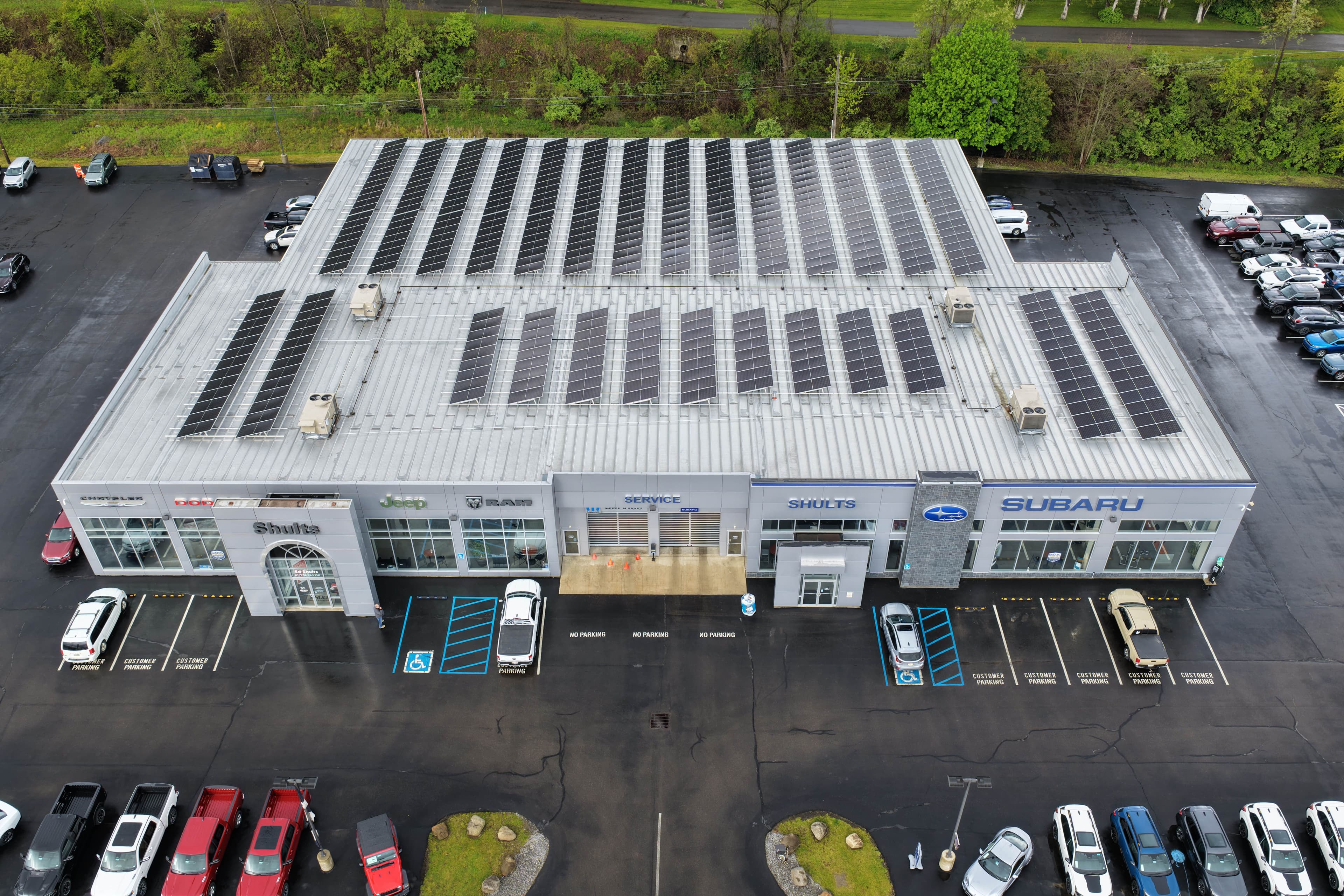
For forward-thinking auto groups, relying solely on volatile public utility grids introduces an unmitigated risk to net margins. To stabilize its operational overhead and secure long-term energy independence, Shults of Warren partnered with Buffalo Solar to execute a masterclass in commercial real estate optimization. By referencing data compiled in the "Shults of Warren Case Study", this detailed B2B analysis breaks down the technical engineering, financial underwriting, and environmental returns of their newly deployed 227.15 kWDC rooftop solar system.
The Core Challenge: Escalating Operational Overhead in Automotive Retail
Automotive dealerships operate within high-overhead physical environments. Large flat-roof showrooms, climate-controlled service hubs, and constant inventory maintenance demand an incredibly high baseline energy load. As original equipment manufacturers (OEMs) demand rapid dealership compliance for fast-charging EV networks, localized power demands are projected to double over the next decade.
Without intervention, these rising utility expenses represent a permanent drain on cash flow. Shults of Warren identified its underutilized roof space as a strategic real estate asset. The goal was clear:
- Reduce immediate energy costs.
- Hedge against unpredictable, rising utility rate hikes.
- Maximize federal, state, and regional commercial tax incentives.
- Deploy a reliable, long-term sustainable power infrastructure engineered to perform optimally for a minimum 25-year lifecycle.
The Core Challenge: Escalating Operational Overhead in Automotive Retail
Automotive dealerships operate within high-overhead physical environments. Large flat-roof showrooms, climate-controlled service hubs, and constant inventory maintenance demand an incredibly high baseline energy load. As original equipment manufacturers (OEMs) demand rapid dealership compliance for fast-charging EV networks, localized power demands are projected to double over the next decade.
Without intervention, these rising utility expenses represent a permanent drain on cash flow. Shults of Warren identified its underutilized roof space as a strategic real estate asset. The goal was clear:
- Reduce energy costs across the entire facility footprint.
- Protect against rising electricity rates and volatile public utility pricing.
- Maximize tax and grant incentives at the state and federal levels.
- Provide long-term, sustainable power with reliable, guaranteed performance for the next 25 years.
Technical Architecture & Commercial Engineering Specifications
Achieving heavy commercial load offsets requires high-performance components and structural precision. Buffalo Solar custom-engineered a roof-mounted photovoltaic array specifically configured to maximize irradiance capture while maintaining the architectural integrity of the dealership's facility.
The physical installation features 413 premium Tier 1 modules, ensuring the system benefits from lower annual degradation rates, exceptional low-light performance (critical for Northeast climates), and robust long-term power generation. This extensive array delivers a total system size of 227.15 kWDC, meticulously engineered to achieve a target annual load offset of 78% of the facility's total energy usage.
The system architecture utilizes 3 advanced commercial inverters. Rather than relying on a single centralized inverter—which creates a single point of failure for the entire asset—Buffalo Solar designed structural redundancy into the array. These inverters balance voltage inputs across the array, minimizing localized shading losses from rooftop HVAC units and ensuring the dealership maximizes its solar harvesting curves from sunrise to sunset.
The Financial Underwriting: Translating Kilowatts into Corporate Cash Flow
While the environmental impact of commercial solar is undeniable, a B2B capital expenditure must stand on its own financial merits. The financial modeling for the Shults of Warren asset demonstrates an exceptional internal rate of return (IRR) and immediate cash-flow optimization.
Quantifying the Financial Returns
- Immediate Monthly Operating Savings: Upon system activation, the dealership slashed its grid reliance, yielding an estimated operational savings of $3,355 monthly.
- Annual Net Working Capital Injection: On an annualized basis, this shifts $40,261 yearly from a variable utility expense directly back into net operating income. This capital can be instantly redeployed to fund vehicle inventory acquisitions, digital marketing campaigns, or service bay expansions.
- 25-Year Cumulative Asset Valuation: Over the warrantied operational life of the tier-one infrastructure, the system is projected to deliver a massive $1,006,539 in 25 years.
Maximizing Commercial Tax Incentives and Subsidies
By converting utility liabilities into a stabilized capital improvement project, commercial enterprises unlock substantial tax mitigations. Under current tax regulations, projects like the Shults of Warren installation qualify for federal investment tax credits, accelerated depreciation models, and regional clean energy grants that offset upfront engineering, procurement, and construction (EPC) costs to sharply compress the payback period.
Environmental Remediation & Corporate ESG Metrics
Modern B2B enterprises are increasingly evaluated on Environmental, Social, and Governance (ESG) criteria by consumers, lending institutions, and corporate partners. By modernizing its energy infrastructure, Shults of Warren aligns perfectly with New York State’s ambitious Renewable Energy Portfolio standards while driving measurable, localized environmental remediation.
Based on verified EPA carbon equivalency models, the 227.15 kWDC array offsets massive volumes of carbon-intensive grid generation. The lifetime metrics achieved by this single commercial roof are staggering:
- Forestland Preservation: The system offsets carbon emissions equivalent to saving 210.6 acres of forest annually. Over the 25-year project lifecycle, this totals a lifetime ecological footprint of 4,962 acres.
- Fossil Fuel Displacement: By feeding clean energy back into the local grid, the installation avoids the combustion of 195,715 pounds of coal annually. Over 25 years, this prevents 4,610,258 pounds of lifetime coal burn.
- Vehicular Emissions Mitigation: The array offsets the equivalent of removing 38 passenger vehicles taken off the road annually. Over the system's operational lifetime, that equals a reduction of 898 lifetime vehicles worth of tailpipe emissions.
Conclusion: Future-Proofing Commercial Real Estate with Buffalo Solar
The successful deployment of the solar system at Shults of Warren establishes a definitive blueprint for the commercial automotive industry and broader B2B sectors throughout the Northeast. As grid infrastructure strains under rising energy demands and utility providers continue to pass volatile infrastructure costs down to commercial ratepayers, self-generation is no longer an optional luxury—it is a core competitive advantage.
By transforming an empty, heat-absorbing rooftop into a reliable, grid-tied power plant, Shults of Warren secured over a million dollars in projected cumulative savings, fully insulated its operations against rising utility rates, and established itself as a regional leader in corporate environmental stewardship.
Is Your Commercial Facility Ready for an Energy Audit?
Every month your commercial property remains un-optimized, operational capital is lost to the utility grid. Buffalo Solar provides turnkey Engineering, Procurement, and Construction (EPC) services tailored to maximize financial yield and navigate commercial energy incentives.
Partner with the Experts: Contact Buffalo Solar today to schedule a comprehensive, data-driven solar feasibility assessment for your commercial property and discover how much capital is hiding on your roof.